Share this:



There has always, and continues to be, a need for flexibility in procuring light touch services.
Before the PA23, local authorities regularly procured above-threshold “light touch open frameworks” or “pseudo frameworks/DPS”. Providers who had not tendered at the outset could still join later, either at any time or whenever the authority “reopened” the arrangement. The PCR 2015 “light touch flexibilities” were well utilised.
A light touch contract (“LTC”) is one for the services listed in Schedule 1 to the Procurement Regulations 2024 (“PR24”), including health and social care, education, culture, hospitality, legal, prison, fire and rescue, security and postal services. These are “special regime” contracts, so once they are at or above the light touch threshold, they constitute public contract. Therefore, authorities must have regard to the s12 procurement objectives and, subject to certain exceptions, generally follow the same rules as apply to other public contracts.
Those exceptions, the “light touch flexibilities”, are significant, and include no minimum tendering periods, an additional direct award ground for “user choice”, no mandatory standstill (although always good practice), and, significantly, no requirement to publish KPIs. Modifications are also more straightforward: including no requirement to publish a change notice or the modified contract.
There are essentially two principal routes. First a light touch framework under s45. This approach offers considerable flexibility: the framework agreement need not set out all of the usual section 45(5) detail, may allow direct award of call-offs, the conditions-of-participation rules in s46 do not apply, and there is no maximum term. Second an open framework under s49. This is a “scheme of successive frameworks on substantially the same terms”. New providers may join each time a fresh framework in the scheme opens, but it is not permanently open like a dynamic market, and none of the light touch flexibilities apply to it.
A third, less obvious option is a “flexible framework”. Transparency is key: the tender notice, procurement documents and framework agreement should state clearly when and how the framework will open, and any provider joining later should be required to meet the same conditions of participation and award criteria as the original entrants.
A light touch framework agreement need not list every service to be called off, but that flexibility has its limits. Before publishing a tender notice, the authority must still consider dividing the contract into lots under s8, and the lot structure should be defined at the outset. PA23 does not expressly permit new lots to be added after award. Different lots may, however, commence on different dates during the term, and lot detail need only be provided “so far as it is known” when the notice is published. In each case, the market should be given sufficient clarity to decide whether to bid.
In relation to value, the flexibility is generous: because s74(2) applies, an authority may vary a light touch framework’s estimated value after award without satisfying a "safe harbour and without publishing a change notice. The s12 objectives nevertheless continue to apply. The authority should set a realistic estimate at the outset, monitor actual spend, and modify before the total is exceeded. Over-estimation should also be avoided. An inflated figure may exclude SMEs from meeting the financial standing requirements.
The call-off contract itself cannot be a framework. A framework within a framework is prohibited by s45(8), which applies to a light touch framework.
Assessment summaries and standstill periods are not mandatory but are usually good practice.
This is where the routes differ most. An open framework is closed between openings. It must be reopened at least once in the first three years, and every five years thereafter (it may be opened more frequently, although the practical workload should consider). It is essentially a succession of frameworks on the same terms.
Examples of possible “opening” periods for multi provider open frameworks:
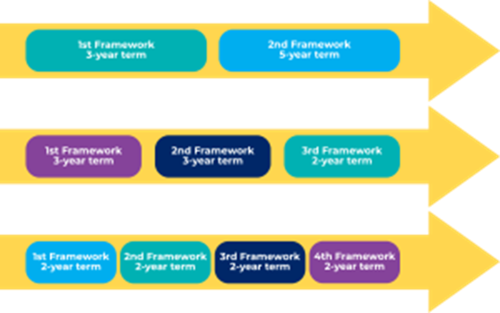
A flexible framework, could be opened at shorter intervals, or opened at the authority’s discretion. That additional freedom, together with the absence of a maximum term, is the principal reason authorities often prefer the s45 light touch route over an open framework, which is capped at eight years.
In both instances, providers who were unsuccessful in the original procurement may reapply to join the framework when it is opened.
On any reopening, in order to ensure transparency and equal treatment, careful thought should be given to existing providers. This is particularly so where direct award is based on ranking. New, applicants should be required to meet the same conditions of participation (as applicable) and award criteria as was used to establish the original framework.
Open frameworks are subject to specific s49 rules. Depending on whether provider numbers are capped, an authority may carry over an existing provider’s place, reassess an earlier tender, or assess a fresh one. Reassessing earlier tenders can be problematic, however, as scores may shift, and a provider could lose its place second time around.
Call-offs may be made by direct award or mini-competition. For light touch services the selection criteria may reflect matters including user choice, need, and the proximity between provider and service recipient. It is advisable that the framework agreement fully sets out the call-off process. (This assists officers who may change over the term of the framework) and keeps the procurement documents consistent. Two points to bear in mind are: (as stated above), (1) a framework within a framework is not permitted and so a call-off contract cannot, in effect, be a new framework, and (2) an award notice followed by a contract details notice are required for above-threshold call-offs.
A dynamic market (“DM”) may offer an alternative. A DM is an always-open list of qualified providers, but it carries no light touch flexibilities, its membership conditions are fixed once established, and it does not permit direct award. Therefore, it will not suit urgent or user-choice situations. For many authorities, this is the reason why the light touch and flexible framework routes remain attractive.
The flexibilities are there to be used: provided the s12 objectives are met, there is considerable scope to design an arrangement that genuinely works for the authority and its market.
No cases have yet been decided under the PA23 in relation to light touch contracts or frameworks, so it remains uncertain how the courts will interpret and apply the rules.
Share this:
 Latest News